

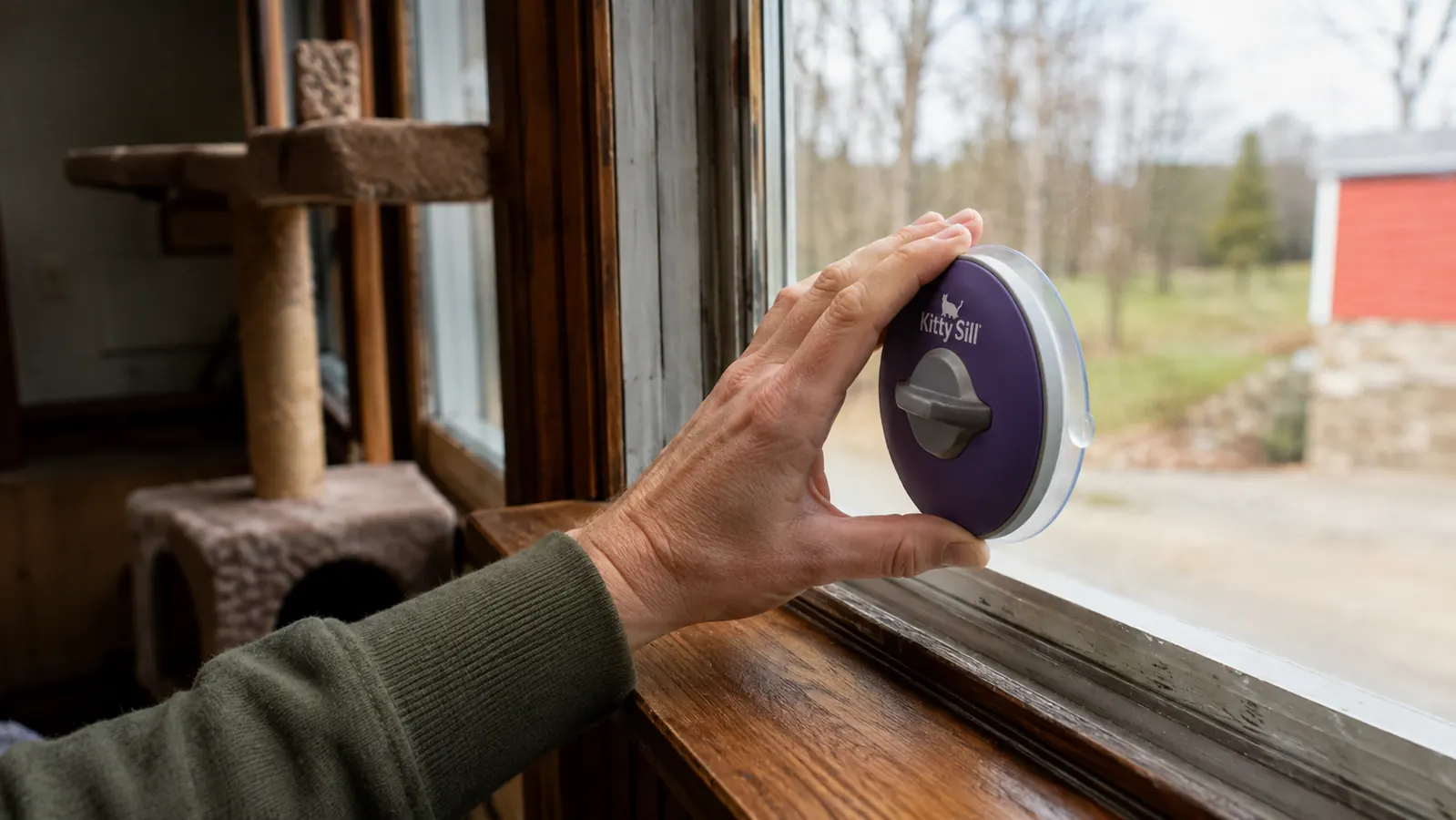
The short answer, after living with a Kitty Sill and a borrowed floor-standing cat tree in the same house for about ten weeks, is that neither one replaces the other. They solve different problems. The Kitty Sill mounts straight to a window and gives one cat first-row seating to the yard, the bird feeder, and every car that comes up the gravel drive. A floor-standing cat tree gives you height, a real scratching surface, and enough room for more than one cat to claim a spot without a standoff. Tuck, my orange tabby, chose the Kitty Sill every single time both options were open to him in the same room, but that's Tuck's preference, not a rule for every cat in every house.
I didn't set this comparison up to crown a winner and call it done. My neighbor Charlene has three cats, and she's run a cat tree in her front room for years because all three of them want to be up off the floor at the same time. I only have Tuck, one cat, one favorite window, so the Kitty Sill was always going to fit my house better than it fits hers. That's really what this whole comparison comes down to: matching the gear to the actual room and the actual number of cats living in it, not picking whichever one has the better product photos.
| Kitty Sill | Cat Tree | |
|---|---|---|
| Mounting requirement | Suction cups need clean, smooth, uncoated glass | Freestanding or wall-anchored, works on any wall or floor |
| Weight ceiling | Rated to 40 lbs, but suction reliability thins out near the top of that range | Base is freestanding, no realistic weight ceiling for a house cat |
| Scratching surface | None built in, fabric cover isn't meant for claws | Sisal-wrapped posts double as a legitimate scratching post |
| Multiple cats at once | One perch, realistically one cat at a time | Several platforms, more than one cat can claim a spot at once |
| Direct sun and window view | Sits right against the glass, full sun and full outside view | Usually set back from the window, view is often partially blocked |
| Floor space used | Near zero, mounts entirely to the window | Real footprint, often two feet square or more once assembled |
| Setup time | About 10 minutes with a glass cleaner and a level | An hour or more assembling posts, platforms, and hardware |
| Current price range | Roughly $44 at today's pricing | Typically $60 to $120 depending on height and platform count |
| Ongoing maintenance | Monthly suction check, more often in cold weather | No suction to maintain, just an occasional wobble check on the joints |
How I Set This Comparison Up
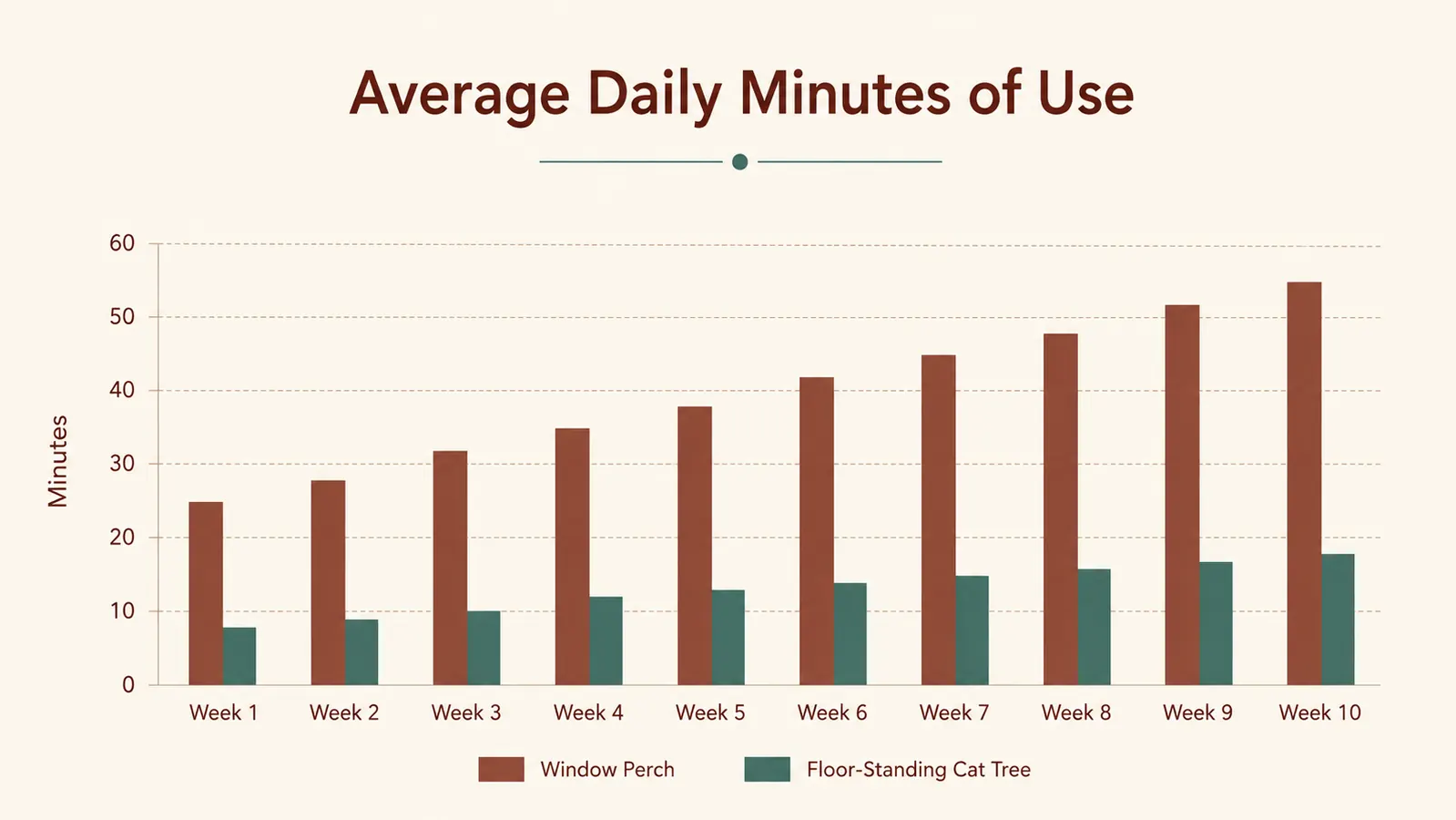
For about ten weeks I had both pieces of gear in the kitchen at the same time, the Kitty Sill on the south window where it's lived for a year now, and Charlene's spare cat tree set up against the opposite wall so Tuck had a real choice every single day instead of just one option to accept. I wanted to see whether he'd split his time between the two or settle firmly on one, and I kept a rough tally on the kitchen calendar of where he was napping whenever I walked past, which given how often I'm in and out of that kitchen ended up being a decent sample size by the end of the ten weeks.
Tuck settled on the Kitty Sill within the first few days and mostly stayed there, using the cat tree maybe a handful of times total, usually right after I'd sprinkled a little catnip on the middle platform to see if I could bribe him into giving it a fair shot. That's a one-cat result and I want to be honest about how small a sample that is. Charlene's own experience with three cats sharing one cat tree at her place looks nothing like my ten weeks with Tuck and the Kitty Sill, and both results are true at the same time for different households.
Where the Kitty Sill Wins
The Kitty Sill wins on exactly what it was built for, which is putting a cat as close to the actual outside world as glass allows. Tuck isn't watching a wall or the back of the couch from the cat tree's middle platform, he's got his nose an inch from the pane, tracking the bird feeder and whatever's moving on the gravel drive. That view is the entire reason he picked it over and over, and no amount of catnip on the cat tree closed that gap. If your cat already parks at a window out of habit the way Tuck did, the Kitty Sill is meeting a preference that's already there rather than trying to create a new one.
It also wins on floor space and setup, which matters more than people expect until they've actually assembled a cat tree in a small kitchen. The Kitty Sill took about ten minutes to mount and uses zero floor space, which was the deciding factor for my house since the kitchen doesn't have room to spare for a two-foot base once you count the table, the dog beds, and Gene's boots by the back door. At current pricing the Kitty Sill also comes in cheaper than most of the cat trees I looked at, which isn't the whole decision but isn't nothing either.
Where the Cat Tree Wins
The cat tree wins on everything that doesn't depend on a pane of glass, and that's a longer list than I expected going in. It works on any wall in the house, no suction, no glass condition to worry about, no cold-morning failures the way the Kitty Sill has had twice in a year. If your windows are textured, leaded, frosted, or coated in privacy film, the cat tree simply doesn't care, because it isn't asking the glass to do any work at all. There's no weight-limit anxiety either, no watching a heavier cat land at a dead run and hoping the suction holds, because the base is sitting on the floor doing what floors do.
It also wins decisively if you've got more than one cat. Charlene's front room has three cats sharing the same space all day, and a single window perch would turn into a turf war within a day. Her cat tree has enough platforms that two or even three cats can be up off the floor simultaneously without anyone getting shoved off a ledge, and it comes with a real sisal scratching surface built into the posts, which the Kitty Sill doesn't offer at all. If your cat needs somewhere to scratch as much as somewhere to perch, the cat tree is doing double duty the Kitty Sill was never designed to do.
If your cat already camps out at the window, this is the gear that meets that habit halfway
The Kitty Sill won on view, setup time, and floor space in our head-to-head. Check today's price and measure your glass and sill depth before you order.
Amazon Check Today's Price on Amazon →Space, Windows, and What Your Room Actually Allows
Before you compare these two on personality or price, compare them on your actual room, because that eliminates half the decision on its own. Run a flat palm across the lower third of the window you're considering. If it's smooth, clean, and uncoated, the Kitty Sill is a real option. If it's textured, leaded, frosted, or filmed for privacy, it isn't, full stop, no matter how badly your cat wants to be at that particular window. I learned that the hard way trying a second Kitty Sill on my mudroom's old leaded glass, and no amount of cleaning fixed what was fundamentally a glass problem, not a product defect.
The cat tree's constraint is floor space, not glass condition, and that constraint is usually easier to work around since you can put it against basically any wall in any room. But don't underestimate how much room a decent cat tree actually needs once it's assembled. Charlene's takes up a solid two and a half feet of floor in a room that isn't huge to begin with, and she's had to rearrange furniture around it more than once. If your house is tight on floor space the way mine is, that's a real cost the Kitty Sill simply doesn't carry.

If You Have More Than One Cat
This is where the math shifts hardest in the cat tree's favor. One Kitty Sill really does serve one cat well, and while a determined second cat could theoretically share it, in practice that turns into exactly the kind of standoff you'd expect from two cats and one good window seat. I don't have that problem since Tuck is an only cat, but Charlene's house tells a different story. A cat tree with three or four platforms spreads that competition out across enough real estate that her cats mostly leave each other alone, which is worth a lot in a multi-cat house even before you get to the scratching surface.
If you're set on giving multiple cats window access specifically, the honest fix is more than one Kitty Sill on more than one window rather than expecting one perch to serve a houseful of cats. That gets expensive fast compared to a single cat tree that handles the same number of cats in one piece of furniture. So the math really does depend on how many cats you're feeding, not just how many you're trying to entertain.
One good window seat and two cats who both want it is a math problem, not a personality problem, and no amount of training fixes math.
Who Should Buy Which
Buy the Kitty Sill if you've got one cat, or a small household of cats who already get along, a smooth clean window with a bit of sill depth, and a room that doesn't have floor space to spare. It's cheaper, faster to set up, and gives a genuinely better view than most cat trees manage, and I wrote up the full year of living with one, cold mornings and all, in this longer Kitty Sill review. Buy the cat tree instead if your windows won't cooperate with suction, if you've got more than one cat competing for space, or if scratching behavior is as much of a problem as perching behavior, since the Kitty Sill doesn't address that at all. Plenty of houses, mine included eventually, end up wanting both for different rooms and different reasons, and that's a perfectly honest answer even if it's less tidy than picking a single winner. If you want the fuller case for why a window perch earns a spot in the first place, this rundown of ten reasons covers the ground I didn't get to here.
Ready to see if your window setup makes the Kitty Sill an easy yes
Check the glass, measure the sill, and see today's price before you decide between a window perch and a floor cat tree.
Amazon Check Today's Price on Amazon →