

Ruggles is a seven-year-old Lab and hound mix who treats every meal like it might be taken away from him. Kibble, a stolen crust of toast, a rogue chicken bone off the counter, all of it disappears in about four seconds flat. So when I started giving him Greenies dental chews six months ago, my first worry was never whether his breath would improve. It was whether he would actually chew the thing before it went down his throat whole, and whether I was setting myself up for a bad night at the emergency vet.
That worry turned out to be the right one to have, and it is the kind of thing most reviews skip straight past on their way to five stars. This is not that review. I have used Greenies daily on two dogs with completely different mouths, completely different chewing styles, and completely different needs, and I have opinions about the parts of the bag nobody reads out loud before they buy. Some of it is genuinely good. Some of it needed a change in how I hand the thing over in the first place.
The Quick Verdict
Greenies do what they say on tartar and breath, but they are not a treat you can hand over and walk away from, and the sizing matters more than the marketing lets on.
Amazon Check Today's Price →Before you buy the wrong size bag twice like I did
Check the current sizing chart and today's price on Amazon before you order, because the size on the front of the bag is not a suggestion.
Amazon Check Today's Price on Amazon →How I've Used It
I feed Greenies once a day, in the evening, to Ruggles and to Pearl, my twelve-year-old Cattle Dog mix. That is the entire routine. No brushing schedule to remember, no special water additive, just one chew handed over after dinner while Gene is getting ready for his night shift and the kitchen finally quiets down. Six months of that is long enough to see what actually happens instead of what the label promises on the front of the bag.
The two dogs could not be more different customers for the same product. Ruggles is a gulper who wants to finish first, whatever "first" even means when Pearl is not racing him and could not care less. Pearl is twelve, going deaf, and takes her time with everything now, including a chew that would have been gone in ninety seconds five years ago. Watching the same bag of Greenies get used two completely different ways is honestly the most useful part of this whole test, because it showed me the product's limits faster than either dog alone would have.
I did not change anything else about their routine. Same kibble, same walks around the fence line, same water bowl by the mudroom door. If their teeth looked different at the end of six months, the chew was the reason, and I wanted to be able to say that honestly instead of crediting a product for something else I changed at the same time without noticing.
The Choking Risk Nobody Puts on the Front of the Bag
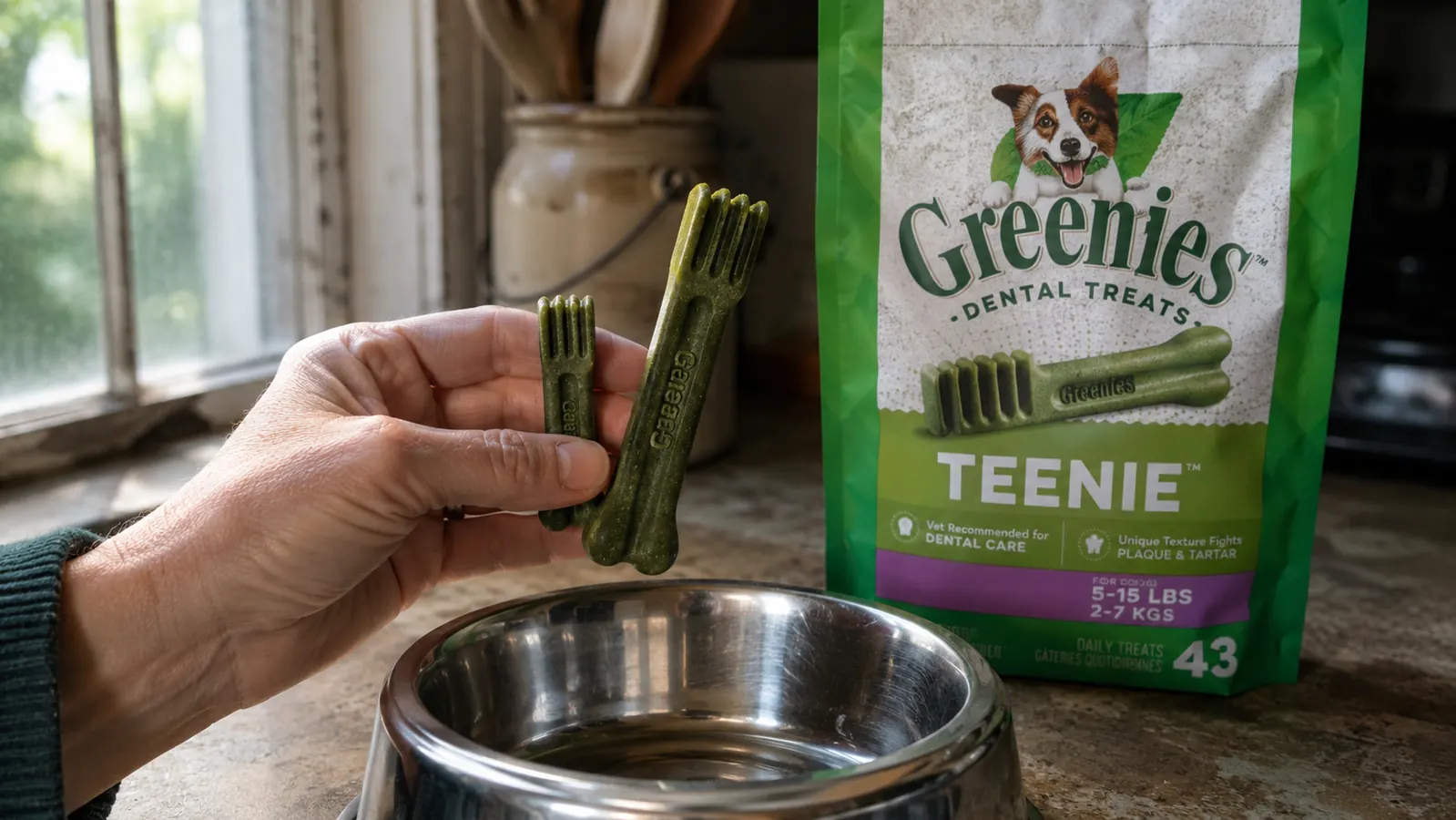
Here is the part I wish someone had told me before the first week. Greenies chews soften as a dog works them, which is exactly how they are supposed to scrape tartar off the back molars over the course of a few minutes of chewing. But a dog who does not actually chew, who mouths it twice and tries to swallow a still-firm chunk, is doing something the product was never designed for. Ruggles tried this exact move on night three, and I watched him gag and then work it back up before it went anywhere serious.
That was enough to change how I handle it permanently. I do not hand a Greenies chew to either dog and leave the room anymore. I stay in the kitchen, I watch the first two minutes, and if a dog is trying to gulp instead of gnaw, I take it back and try again after they have calmed down. This is not a rare warning buried in fine print somewhere. Vets bring up gulping and choking risk with dental chews often enough that it should be part of the normal instructions handed to every new buyer, not an afterthought printed in tiny type on the back panel.
Size matters here more than I expected going in. A chew sized for a small dog's mouth breaks apart faster under the jaws of a bigger, more aggressive chewer, which raises the odds of a chunk going down before it has softened enough to be safe. If your dog is a known gulper, plan on supervising every single chew, every time, for as long as you keep buying them. That is not a one-time adjustment period. It is the ongoing cost of feeding this to a dog who does not naturally slow down.
Sizing Confusion Cost Us a Second Bag
The bag I started with was sized for smaller mouths, and it worked fine for Pearl, who is not a huge dog and chews carefully anyway even at her age. Ruggles is built differently, longer muzzle, bigger jaw, and a chew sized for a smaller dog disappeared too fast in his mouth to do the scraping work it is supposed to do. I ended up needing a second size for him specifically, which meant tracking two different bags instead of one, and remembering which dog got which chew every single evening.
Nobody warns you about this part clearly enough before you check out. The sizing chart on Greenies packaging is based on weight ranges, and it is worth reading closely before you order rather than guessing from the picture on the front of the bag. Buy the wrong size and you either waste money on a chew that vanishes in ten seconds and does nothing for the teeth, or you hand an undersized dog a chew built for something twice its size, which circles right back to the choking risk from a different angle.
Once I had the right size for each dog, the two-bag system became just another line item in the pantry, alongside the flea prevention and the fish oil. It works, but it is one more thing to track, and one more thing that costs real money every single month, which brings me to the habit itself rather than any one bag sitting on the shelf.
What Six Months and a Vet Visit Actually Confirmed
I did not just take my own nose's word for it. Pearl had a dental check at month five, mostly because she is twelve and I like to keep an eye on her mouth given her age and her stiffer hips these days. The vet noted less tartar buildup along her back molars compared to her chart from the year before, and specifically asked what we had changed. Daily Greenies was the honest answer, alongside nothing else different in her care that visit.
That confirmation mattered to me more than my own sense of smell did, because breath is subjective and I wanted something closer to an actual measurement from someone who was not just being polite about my dog. It is worth saying plainly that a daily chew is not a substitute for actual veterinary dental cleanings, especially in an older dog like Pearl. She still needs her teeth checked regularly. Greenies slowed the buildup between visits. It did not replace the visits, and I would not want anyone reading this to think it could.
Ruggles has not needed a comparable dental visit yet, so I cannot give him the same third-party confirmation. His breath is better and there is visibly less buildup near his gumline when I check, but I am not going to claim a vet-verified result for a dog who has not had one. That is the kind of overclaiming I try hard to avoid, even when the bag is sitting right there working as advertised.
The Calorie Math Nobody Mentions
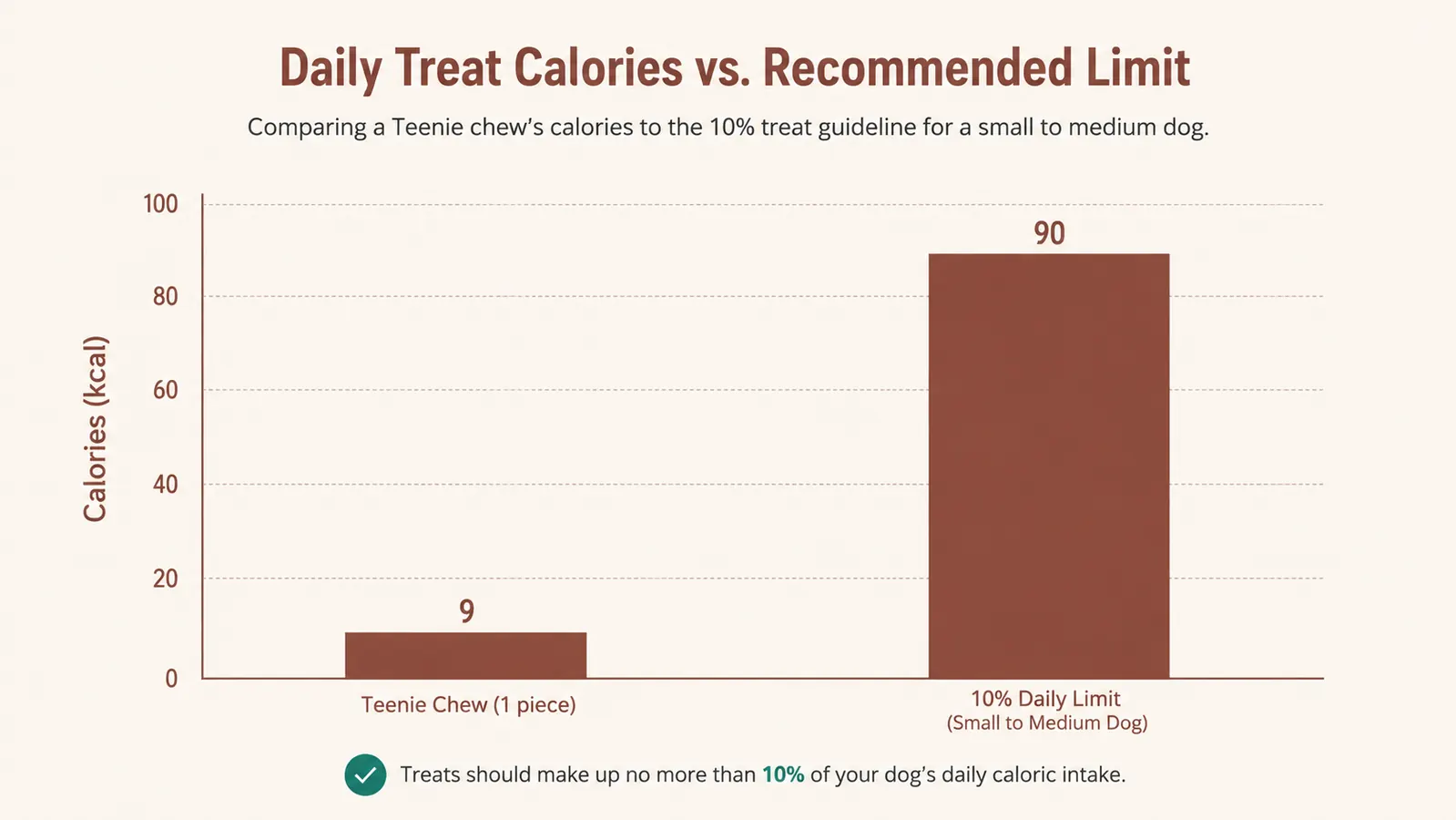
A daily dental chew is still a daily treat, and treats have calories that count against a dog's total intake for the day. This sounds obvious written out, but it is easy to forget when the packaging is styled more like a health product than a snack you would think twice about. For a smaller or less active dog, a chew every single day can add up to a meaningful chunk of daily calories, especially stacked on top of regular treats during training or just general spoiling from a soft-hearted owner.
Pearl is the dog I actually worry about here. Her hips have gotten stiffer with age, she moves less than she used to, and she sleeps most of the afternoon by the wood stove instead of patrolling the fence line like she did at six. Adding a daily chew to a dog who is burning fewer calories than she used to is exactly the kind of thing that creeps up on you a few pounds at a time if you are not paying attention to her weight at every checkup.
I have not cut Greenies out of her routine, but I did trim back one of her other daily treats to make room for it calorie-wise, and I check her weight at the vet more often than I used to. If your dog is already carrying extra weight, or is the sedentary type who sleeps more than she moves, that is a real conversation to have with a vet before adding any daily chew, dental or otherwise, on top of everything else she already eats in a day.

What Else I Considered
Before settling into a daily Greenies routine, I looked at plain old toothbrushing and a couple of the other dental chew brands on the shelf next to it. Brushing works if you can actually get it done every day, but between Ruggles squirming and Pearl's patience running thin fast at her age, it was not realistic for us to keep up seven days a week. A chew that both dogs would take without a fight was worth more to our actual routine than a brushing kit sitting unused in a drawer.
I also compared notes against Dentastix, which is the other name that comes up constantly in the same aisle. The texture is different enough that the two are not interchangeable, and I go into that comparison in more depth in a separate piece rather than turning this review into a side-by-side. For our purposes, Greenies won out because Pearl actually finished hers reliably, and a chew a dog refuses to eat does nothing for anyone's teeth no matter how good the ingredient list looks on paper.
What I Liked
- Vet-confirmed reduction in tartar buildup on Pearl's back molars by month five
- Genuine breath improvement on both dogs within the first few weeks
- Simple one-a-day routine that requires no brushing schedule or extra tools
- Widely available with a huge number of existing reviews to cross-check against
Where It Falls Short
- Real choking and gulping risk if the wrong size is used or the dog is unsupervised
- Sizing chart mistakes are easy to make and can mean buying a second bag
- Daily calories add up and matter more for less active or overweight dogs
- Does not replace actual veterinary dental cleanings, especially for older dogs
- Cost of feeding it daily to two dogs of different sizes is an ongoing household expense, not a one-time purchase
A daily dental chew is still a daily treat. It has calories, it has a size that has to match the dog, and it is not a replacement for the vet. Anyone who tells you otherwise is selling you something.
Who This Is For
Greenies made sense for us because we have two dogs who both chew, just at different speeds, and because I was willing to supervise the first few minutes of every chew rather than tossing it and walking off to start dinner. If you have a dog who chews thoroughly rather than gulping, who is at a healthy weight with room in the daily calorie budget for a treat, and whose size matches an actual size option on the chart rather than a guess, this is a reasonable daily habit to build. It is also worth reading about how the routine held up over the full six months in the long-term Greenies review, and about the specific breath change we noticed early on in the breath story if that is your main concern going in.
Who Should Skip It
Skip it, or at least slow way down, if your dog is a known gulper who does not settle in to actually work a chew, because that is a real choking risk and not a hypothetical one dreamed up for a warning label. Skip it if your dog is already overweight or mostly sedentary, since a daily chew adds calories you will need to account for somewhere else in their diet. And do not treat it as a substitute for a dental cleaning if your dog is older or already has known dental issues. A chew slows buildup between visits. It does not undo damage that is already there, and no bag on a shelf is going to tell you that part before you check out.
Right size, supervised, and calorie-aware, it earns its spot in the pantry
See current sizing options and today's price on Amazon before you order, and match it to your dog's actual weight, not just the picture on the bag.
Amazon Check Today's Price on Amazon →