

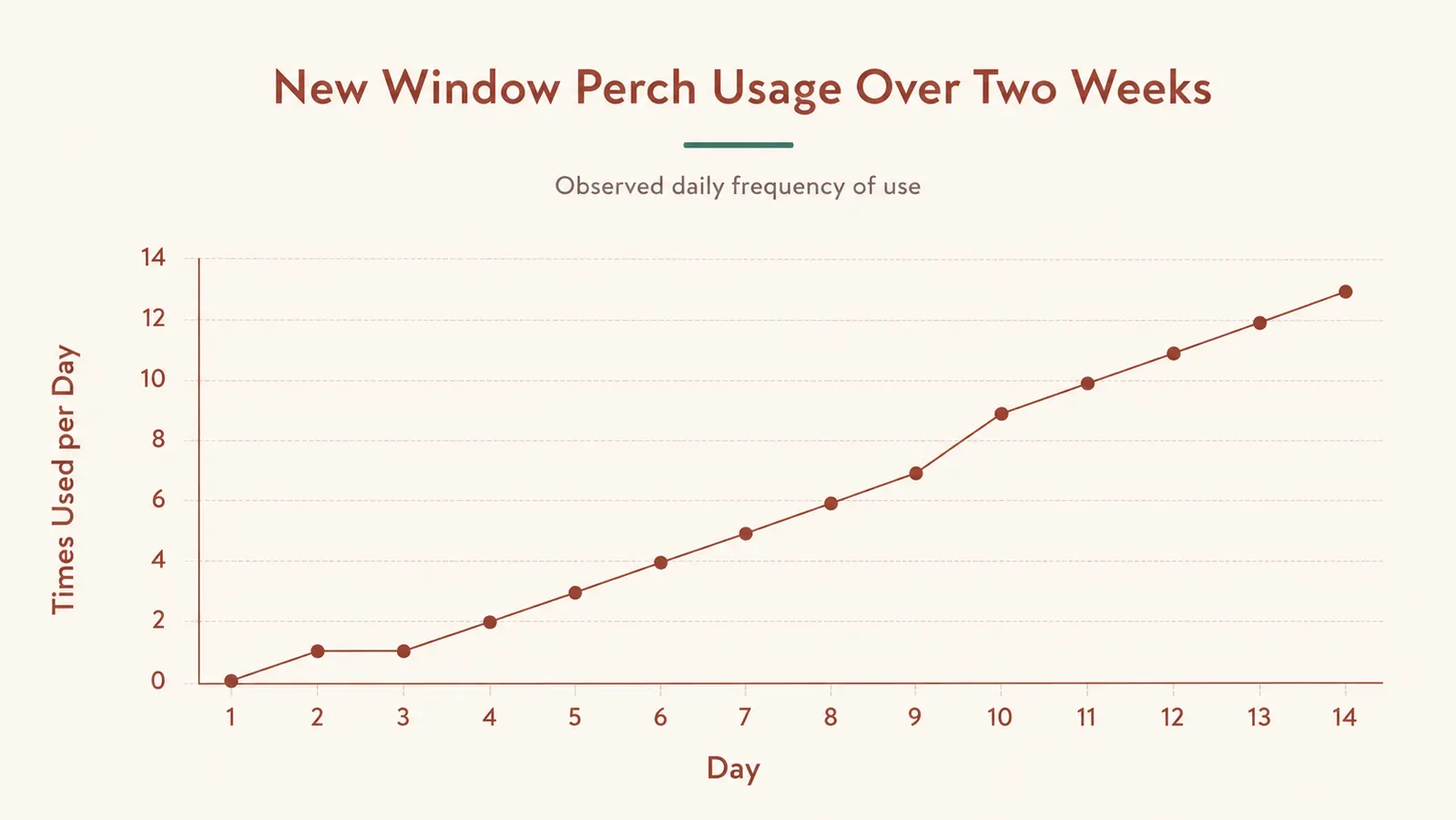
Tuck ignored the Kitty Sill for six straight days. I'd mounted it in the south window the same afternoon it arrived, right where he already sat on the counter every morning glaring at the bird feeder, and I fully expected him to be on it by dinner. Instead he walked past it, sniffed the strap once, and went right back to parking his whole body on top of the microwave, which is somehow his preferred vantage point over an actual padded window seat with a bird's-eye view. It took closer to two weeks before he used it on his own without me hovering nearby, and once he did, he didn't get off it again for the better part of a year.
That gap between installing a window perch and a cat actually deciding it's his is the part nobody warns you about. Most of the advice out there treats a cat like a dog you can just walk over and set on a new bed. Cats do not work that way, and Tuck in particular does not work that way. What follows is the actual routine that got him from ignoring the Kitty Sill entirely to treating it like the best real estate in the house, in the order I'd do it again if I were starting from a bare window tomorrow.
A cat who ignores a new perch isn't rejecting it, he's just not convinced yet
The Kitty Sill gave Tuck a spot with a real view and enough sill depth to actually stretch out on, and once he decided it was his, he used it almost every day for a full year straight. Check today's price before you pick your window.
Amazon Check Today's Price on Amazon →Step 1: Pick a Window He's Already Staring Out Of
Before I bought anything, I spent a few days just watching where Tuck actually chose to sit. Not where I thought a cat should want to sit, where he genuinely parked himself, uninstructed, over and over. For him that was the south kitchen window, because that's the one facing the bird feeder, and he'd already been sitting on the counter beneath it most mornings, tail twitching, making a low chattering noise at every finch that landed. That existing habit told me more about where the Kitty Sill would succeed than anything on the packaging did. I also paid attention to what he did on rainy days, since a cat who still stares out a window during a downpour with nothing moving outside is telling you the view itself matters more to him than the birds passing through it.
Bird traffic matters more than almost anything else in this decision. A window that looks out on a quiet stretch of lawn with nothing moving is a much harder sell than one with a feeder, a bush full of sparrows, or a driveway where the mail carrier shows up at the same time every day. Sun matters too, but less than people assume. Tuck actually prefers the window that gets morning sun and goes shady by early afternoon, since a perch that turns into a greenhouse by noon just gets abandoned for the cooler tile floor.
If you've got more than one candidate window, don't guess. Watch your own cat for a week the way I watched Tuck, and mount the Kitty Sill on whichever pane already gets the most unprompted attention. Trying to talk a cat into a view he's never shown interest in is a losing argument, but building a perch onto a window he's already claiming with his eyes is barely a sales pitch at all.
Step 2: Match the Height to Wherever He Already Launches From
The second mistake I almost made was mounting the Kitty Sill at the height recommended in the instructions instead of the height that matched Tuck's existing habits. He'd been getting to that window by jumping onto the counter first, then up onto the sill itself, a two-step launch he'd worked out entirely on his own. When the Kitty Sill went in slightly higher than the counter he used as his stepping stone, he had to change his whole approach route, which is exactly the kind of small friction that keeps a cat from bothering with something new.
I ended up remounting it about two inches lower, level enough with the counter that his existing jump carried him straight onto the Kitty Sill instead of past it. That one adjustment did more than any coaxing I tried in the first week. Cats are creatures of established motion. If a new perch requires a completely different jump than the one your cat already knows by heart, you're asking him to learn a new skill just to reach the reward, and most cats will simply decline and go sit on the microwave instead.
If your cat doesn't have an obvious existing launch point near the window you've chosen, give him one. A stool, a low shelf, even a stack of sturdy boxes near the sill can bridge that gap while he gets used to the idea, and you can remove it later once the Kitty Sill itself has become the destination he heads for without thinking about the steps in between.
Step 3: Clean the Glass Before the Suction Cups Ever Touch It
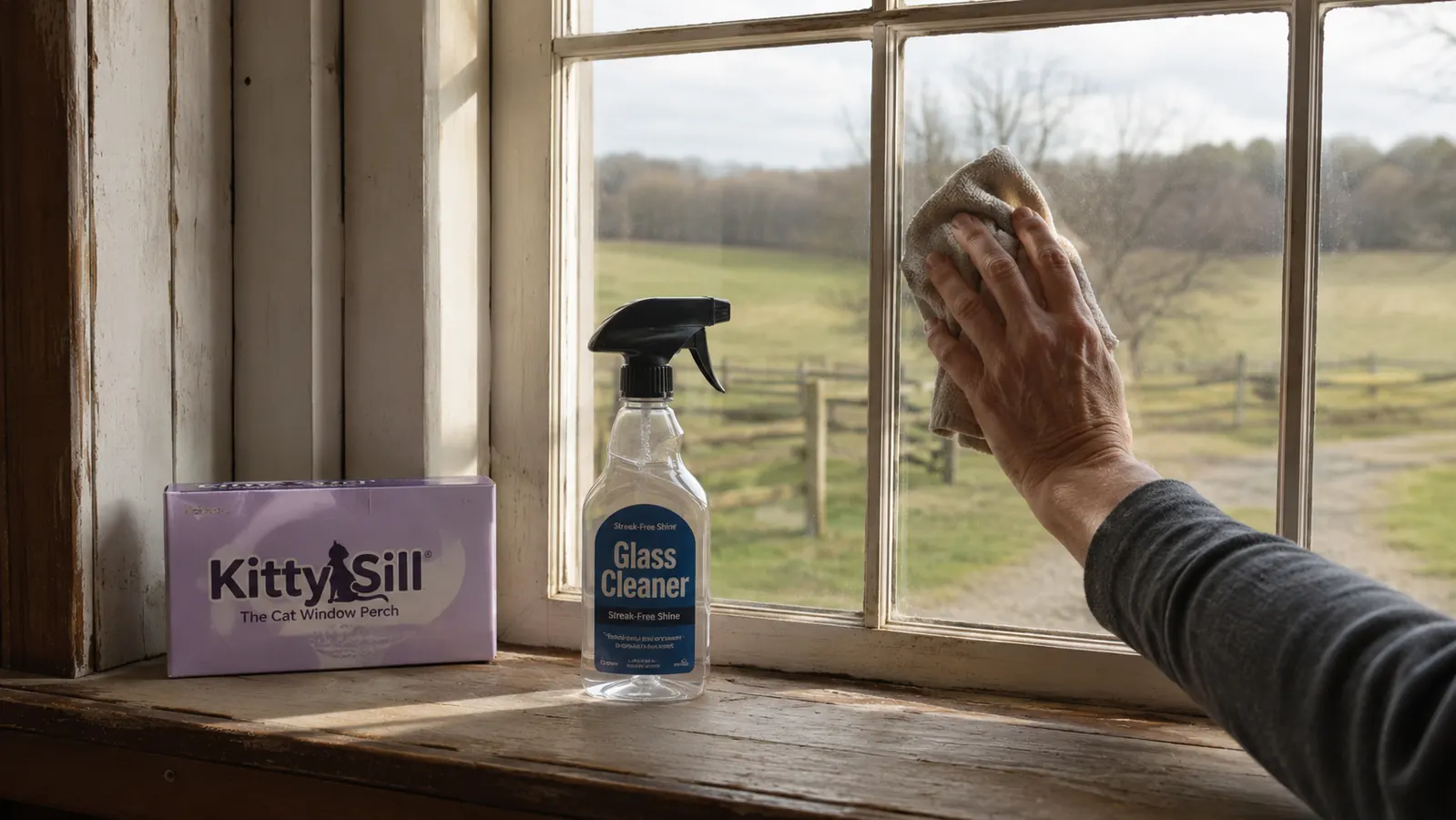
This step has nothing to do with cat psychology and everything to do with why a Kitty Sill falls down mid-nap, which will sour a cat on the whole idea faster than anything else on this list. Suction cups need a genuinely clean, smooth surface to grip, and our farmhouse windows collect a film of cooking grease and dust that isn't visible until you run a hand across the glass and feel it drag instead of squeak. I wipe the exact spot where the cups will sit with plain glass cleaner and a dry cloth, working it until my palm slides across the pane without any resistance at all, before I press a single cup into place. I keep a small spray bottle of glass cleaner and a dedicated cloth in the kitchen drawer closest to that window now, specifically so the excuse of digging out cleaning supplies never becomes a reason to skip this step before a remount.
Do this before the first mount, and then again roughly once a month as maintenance, because grease and dust rebuild slowly even on a window nobody's cooking near directly. A Kitty Sill that comes loose once, even gently, tends to make a cautious cat avoid it entirely afterward, and getting a spooked cat to try again is a much longer project than getting a curious one to try the first time. Clean glass is the cheapest insurance in this whole process, and it's the step people skip because it feels unrelated to training.

Step 4: Transfer His Scent Before He Ever Sees It in Place
Once the Kitty Sill was mounted and holding firm, I draped one of Tuck's favorite blankets over it instead of leaving the bare fabric cover exposed. It was a blanket he already slept on regularly, still carrying his scent, and I left it there for two full days before I ever tried to get him near the window on purpose. Cats orient toward familiar scent long before they trust a new object on sight, and a perch that already smells like him reads as safe territory rather than foreign object the first time he actually investigates it up close.
I've since done the same thing with a second Kitty Sill Alison borrowed for the resident cat at a foster placement, who'd never seen one before, and the scent-transfer step cut the adjustment period down noticeably compared to introducing the bare perch cold. It costs nothing and takes two minutes, and it's the single easiest step on this whole list to skip when you're excited to see your cat use the thing you just bought, which is exactly why it's worth forcing yourself to be patient about.
Step 5: Bait With Treats, Keep Sessions Short, and Never Pick Him Up and Set Him On It
The urge to just pick your cat up and place him on the new perch is strong, and I gave into it exactly once with Tuck. He tolerated it for about four seconds before jumping straight back down and avoiding the Kitty Sill for the rest of that day. Being physically placed somewhere removes a cat's sense that he chose it himself, and choice is most of what makes a perch feel like his territory instead of a spot he was forced onto. Every session after that first mistake, I let him approach entirely on his own terms.
What actually worked was short, low-pressure sessions with treats. I'd set a single treat right at the base of the Kitty Sill, then one a little farther up on the sill itself, letting him work his way toward it over several short visits rather than one long push. Five minutes at a time, once or twice a day, was plenty. Longer sessions just wore his patience down and turned the whole window into something he wanted to avoid rather than investigate.
Give it two full weeks before you decide whether a Kitty Sill is or isn't going to work for your cat. Tuck's own timeline ran almost exactly fourteen days from first ignoring it completely to using it unprompted every single morning, and that stretch felt a lot longer while I was living through it than it looks written down after the fact. A cat who hasn't touched a new perch by day three hasn't rejected it. He's still deciding, and the worst thing you can do in that window is force the issue and prove to him it wasn't worth the wait.
A cat who hasn't touched a new perch by day three hasn't rejected it. He's still deciding, and forcing the issue is the surest way to prove him right.
What Else Helps
Once Tuck actually claimed the Kitty Sill, keeping him on it was easier than getting him there in the first place. Rotating in a fresh treat near the sill every few days for the first month reinforced the habit past the initial two weeks, and I made a point of not moving the perch to a different window once he'd committed to the south pane, since cats don't take kindly to relocating a spot they've already decided is theirs. If you're still weighing whether a mounted perch or a freestanding tree fits your window and your cat's personality better, I laid out the tradeoffs in a full Kitty Sill versus cat tree comparison, and if you want the broader case for why a window perch is worth the effort at all, I covered that separately in ten reasons cats need a window perch. A full year later, Tuck still heads for that same spot most mornings before I've even started the coffee, which is about the only proof I trust that the two weeks of patience actually paid off. I also stopped rearranging the kitchen counter near that window once he'd settled in, since even small changes to his approach path seemed to make him hesitate again for a day or two, which was a good reminder that the routine matters as much after the two weeks as it does during them.
Two weeks of patience is cheaper than a perch gathering dust in the closet
Pick the window your cat already stares out of, match the height to how he already jumps, and give the Kitty Sill two full weeks before you decide anything. Check today's price and measure your sill before you order.
Amazon Check Today's Price on Amazon →