
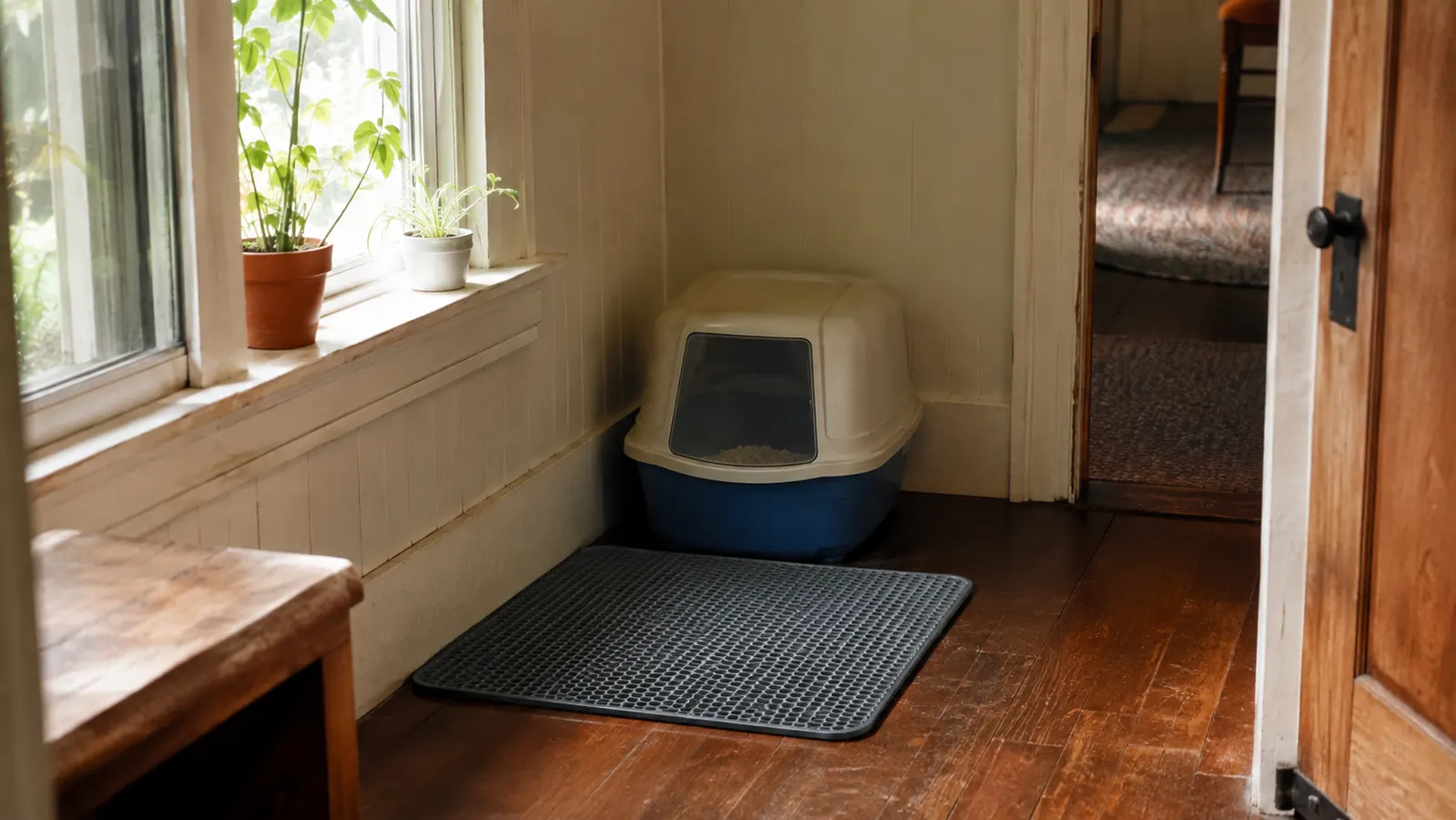
For years the back hall in my house was a litter minefield. The box sits against the wall there, wood floor the whole way through to the kitchen, and every morning I'd find gray granules tracked in a loose trail toward the water dish, sometimes all the way to the stove. Tuck, my orange tabby, is not a delicate digger. He scratches like he's trying to bury something the size of a groundhog, and litter goes everywhere when he's done. I bought the Pieviev double-layer mat almost exactly a year ago hoping it would cut down on the sweeping, not eliminate it, because I've bought enough pet gear by now to know better than to expect a miracle out of a rubber mat.
Twelve months later it's still down in that hall, which by my own rule of thumb already makes it a keeper. Gear that doesn't earn its spot gets shoved in the hall closet inside of a season around here. This one didn't.
The Quick Verdict
A genuinely useful two-layer trap that cuts tracked litter down hard, but it needs a weekly shakeout and the edges take a while to lie flat.
Amazon Check Today's Price →Tired of finding litter three rooms away from the box?
The Pieviev mat is currently one of the better-reviewed honeycomb traps on Amazon, and it's held up a full year in my own back hall.
Amazon Check Today's Price on Amazon →How I've Used It
My setup is about as ordinary as it gets. The litter box sits directly against the mat's long edge in the back hall, and the hall dead-ends into the kitchen doorway about six feet away. That six feet is the whole battlefield. Anything Tuck kicks loose either lands on the mat or it doesn't, and if it doesn't, it's on my kitchen floor by lunchtime.
I didn't change anything else about the routine when I put the Pieviev mat down. Same litter brand, same box, same twice-a-day scoop. I wanted to see what one product change actually did on its own, not what happened when I also switched litter or moved the box, because that's how people end up crediting the wrong thing.
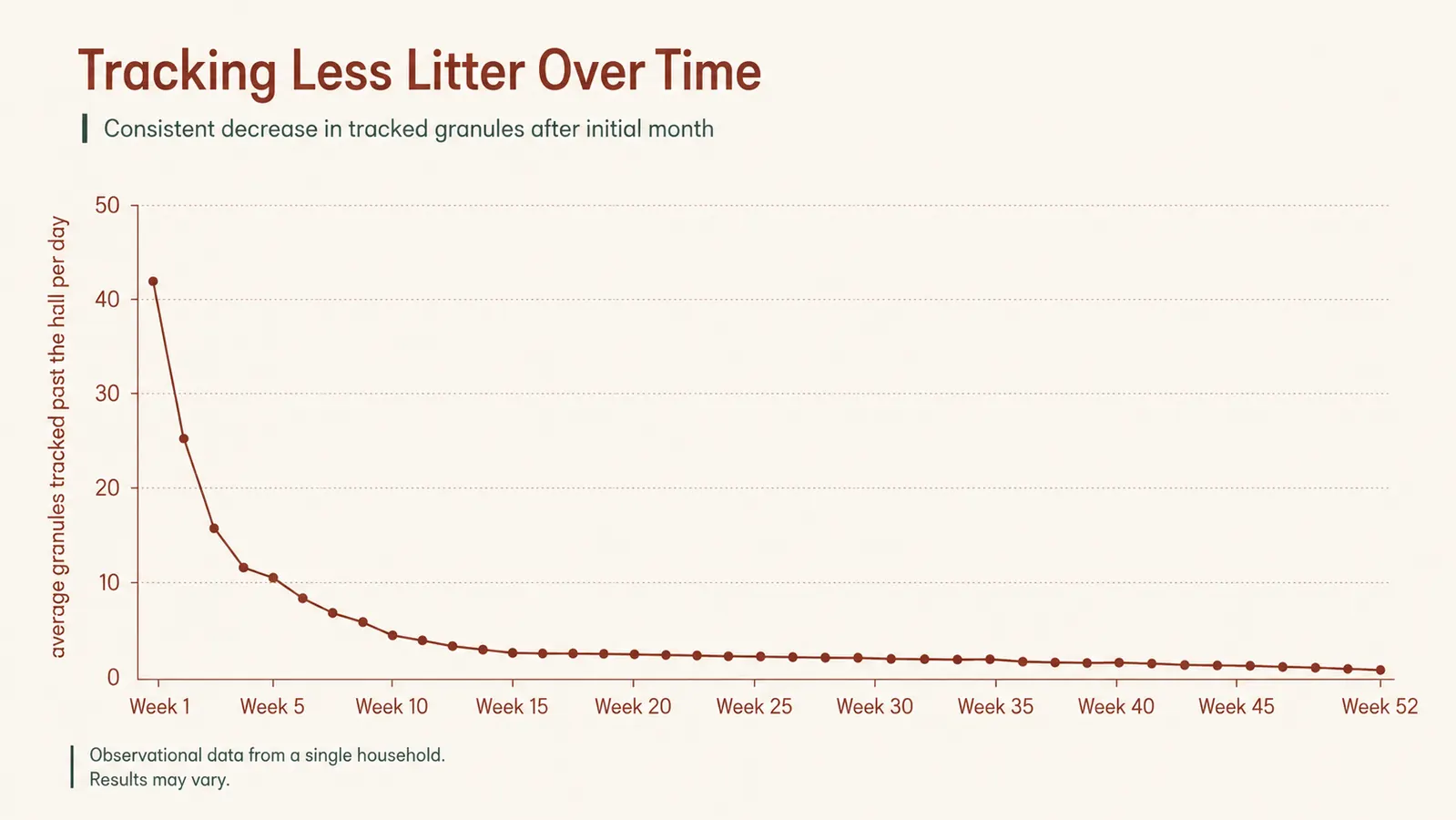
Gene walks that hall barefoot most nights coming in from his shift, and he was my honest, unscientific measuring stick. Before the mat, he'd step on a stray granule at least a few nights a week and swear about it. After the first month with the Pieviev mat down, that dropped to maybe once every couple of weeks, usually when I'd skipped the shakeout longer than I should have.
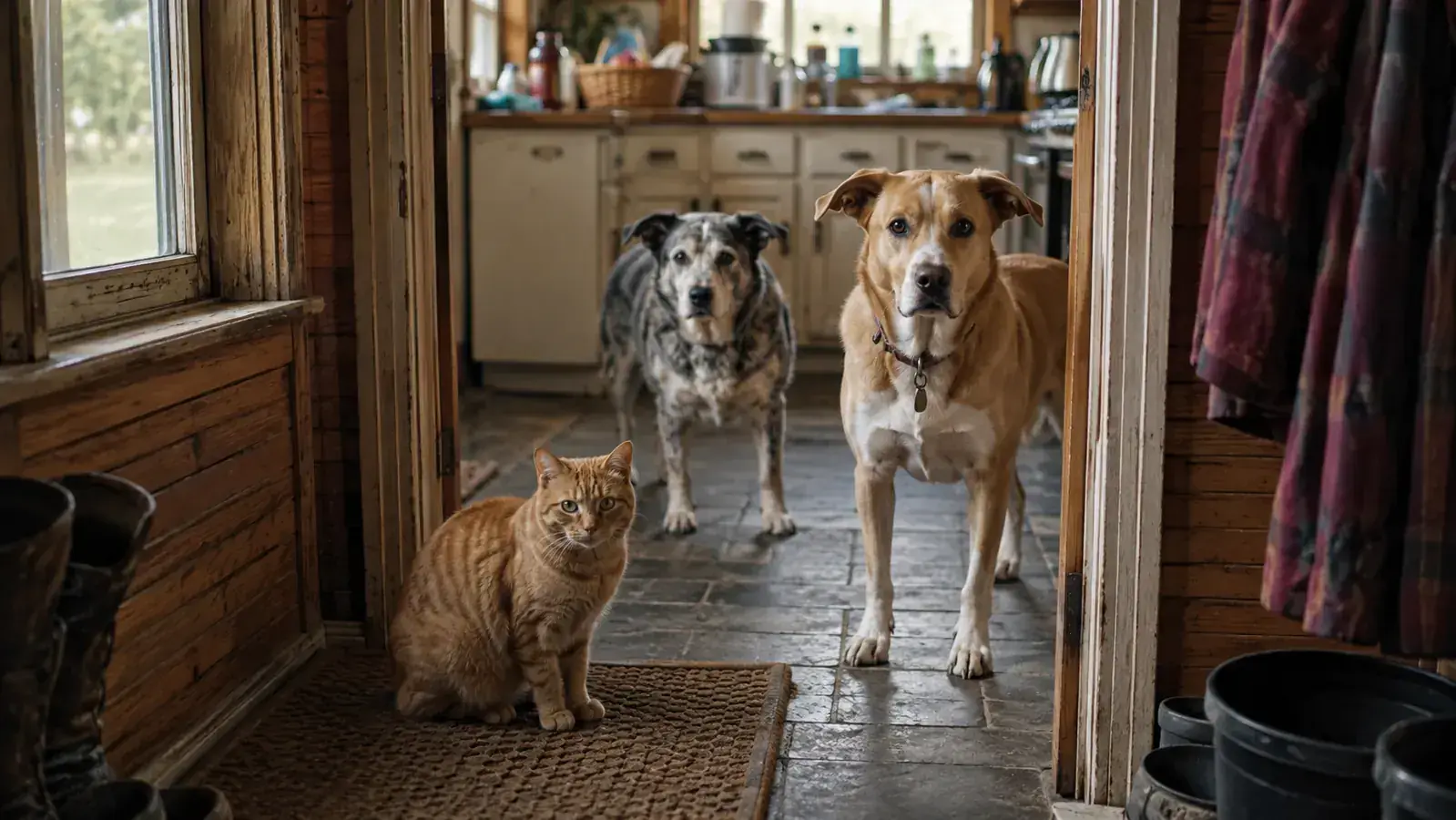
Pearl, my twelve-year-old Cattle Dog mix, sleeps by the wood stove at the other end of the house and mostly stays out of this particular drama, stiff hips and all. But even she used to pick her way carefully through that hall on the rare nights she wandered back for water, and these days she doesn't bother watching her feet through there anymore. Small thing, but it's the kind of small thing that tells you a product is actually doing its job.
The Two-Layer Honeycomb, Actually Explained
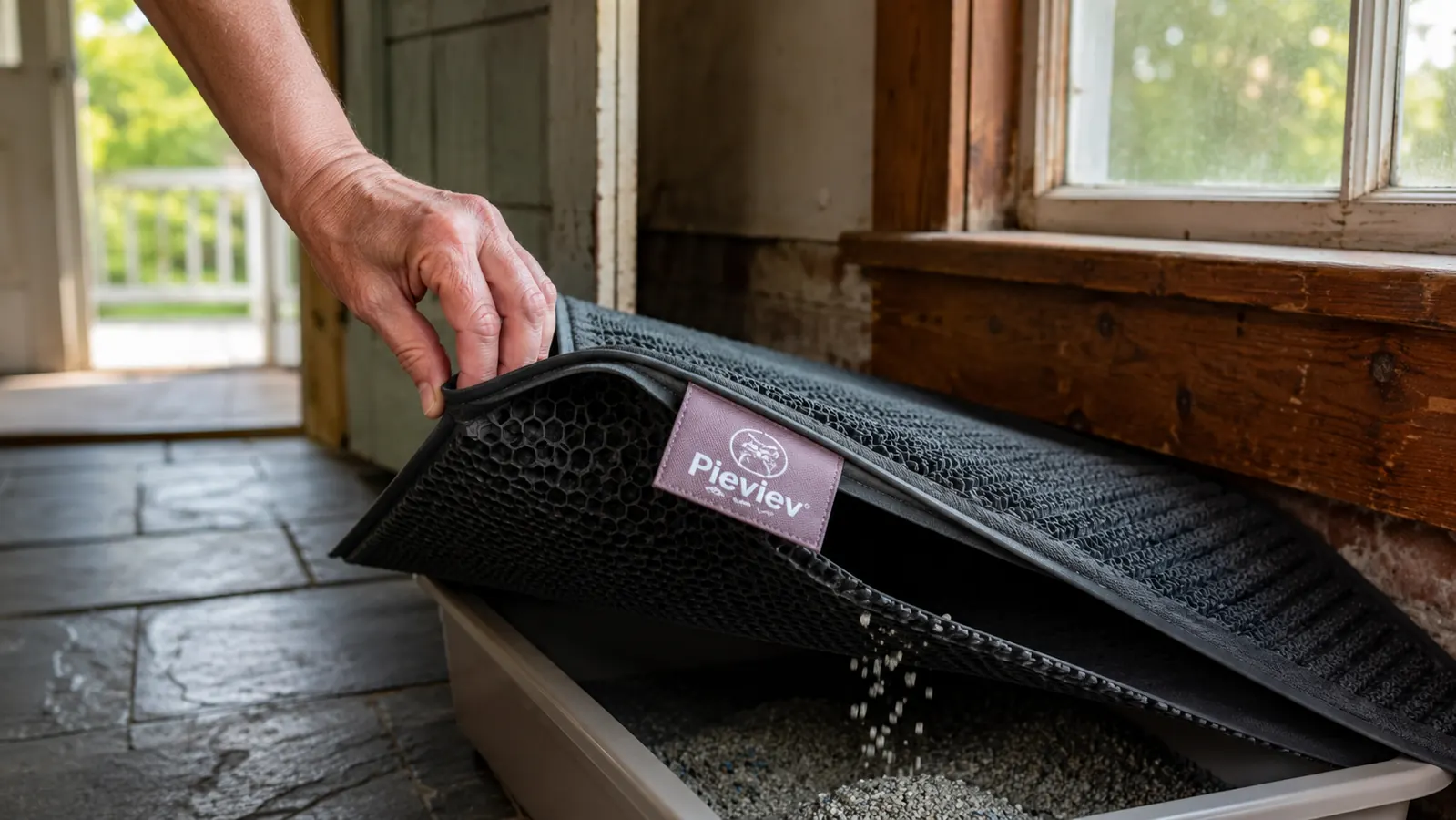
The Pieviev mat works on a simple idea executed reasonably well. The top layer is a grid of honeycomb-shaped holes, each one just wide enough for a paw to sink into slightly as the cat walks off the box. Any litter clinging to the paw gets knocked loose through those holes and falls into a second, solid layer underneath. That bottom layer is what actually holds the litter until you deal with it. Without it, you'd just have a fancy-looking mat that let litter fall straight through onto your floor, which defeats the whole point.
What makes the honeycomb pattern work better than a flat textured mat, in my experience, is that the holes force contact. A smooth surface lets a cat glide off without ever really pressing a paw down, but Tuck has to actually step into those little wells on his way out, and that's when the loose granules get knocked free. It's not perfect. Fine, sandy litter dust still rides along on the fur between his toes and shows up a foot or two past the mat sometimes. But the bigger granules, the ones that actually hurt to step on barefoot, mostly stay put.
The material itself is EVA foam, the same rubbery stuff you find in gym mats and some kids' play tiles. It's soft enough to give slightly under a paw but firm enough that it doesn't collapse flat and stop trapping anything. A year in, mine hasn't cracked or torn at the honeycomb edges, which is more than I can say for a couple of cheaper vinyl mats I tried before this one.
Emptying It: The Corner-Pour Method
Nobody tells you how you're actually supposed to empty one of these mats, so I'll just describe what works. You lift one corner of the mat, angle it up over the open litter box, and let gravity do the rest. The trapped granules slide down between the honeycomb layer and pour back into the box in a steady little stream. It sounds obvious once you've done it, but the first time I tried it I dumped a small handful onto the floor because I lifted the wrong corner, the one farthest from the box.
The waterproof backing on the Pieviev mat matters more than I expected here. Cats, and Tuck especially, don't always finish their business fully inside the box. A couple of times over the past year he's had a near miss right at the edge, and instead of soaking into my wood floor, it stayed on top of the mat's bottom layer. That waterproof layer is the difference between wiping down a mat and refinishing a floor board, and after twelve months of hall traffic I'm genuinely grateful for it.
Size and Placement in a Real Hallway
The Pieviev mat measures 24 by 15 inches, which sounded small on the product page but turned out to be plenty once I laid it against my box. It covers the whole exit end with a few inches to spare on either side, which matters because Tuck doesn't launch litter in a straight line off the front. He fans out in every direction like he's clearing a runway, so the extra width at the edges catches granules that a narrower mat would have missed entirely.
Ruggles, my seven-year-old Lab and hound mix, has always found the litter box a little too interesting for anyone's comfort, nose first and no shame about it. One side benefit I didn't expect from the honeycomb texture is that it seems to slow him down just enough that Tuck usually clears the area before Ruggles gets his nose anywhere close. Pieviev doesn't advertise that on the box, but a year in, I'll happily take it.
The rubber backing grips the wood floor in my hall well enough on its own. It doesn't slide when Tuck jumps down onto it, and it doesn't bunch up under a vacuum pass the way a thin bath mat does. I never bothered with double-sided tape or any of the anti-slip strips some reviewers mention, and a year of daily foot and paw traffic hasn't budged it out of place.
The Edge-Curl Problem Nobody Warns You About
Straight out of the packaging, the Pieviev mat comes rolled, and the edges fight you for the first couple of weeks. Mine curled up at both short ends and refused to sit flat against the hall floor no matter how I weighted it down. I ended up setting the litter box itself on one curled end and a stack of old phone books on the other for about ten days, which is not a glamorous fix but it worked.
By week three the curl had mostly relaxed out on its own, and by the two-month mark it was lying flat like any other mat. It's worth knowing ahead of time so you don't think you got a defective one. It's just how the material ships, and it settles down with weight and time, not with anything you have to do beyond being a little patient.
Twelve Months of the Weekly Shakeout
The honeycomb trap only works as well as your willingness to actually empty it. I fell into a Sunday-morning habit of lifting the Pieviev mat, giving it that corner pour into the box, and giving the whole thing a shake outside over the gravel drive to knock loose whatever the pour didn't catch. Skip that for two weeks running, which happened more than once, and you start to see fine litter dust working its way out from under the honeycomb edges again.
Across a full year, the mat itself hasn't degraded in any way I can point to. The honeycomb cells haven't torn or flattened out, the color has faded slightly from a darker gray to something a shade lighter under the kitchen window light, and the waterproof backing still holds up under a damp mop pass whenever I want to do more than a shake. I haven't had to buy a second one.
What has changed is how much I trust it without checking. In month one I was lifting a corner almost daily just to see how much it had caught. About halfway through the year I'd settled into once a week being plenty for our household's traffic, which is one cat and a box that gets scooped twice daily. A busier multi-cat house would probably need that shakeout more often.
What I Compared It Against
Before landing on the Pieviev mat I'd tried a flat rubber tray with raised rings, which caught almost nothing because Tuck just stepped over the rings entirely, and a cheap woven doormat that trapped litter fine but was miserable to empty since you had to shake it upside down and hope for the best. I've since put the Pieviev design up against a Gorilla Grip mat a neighbor swears by, and if you want the full side-by-side on depth, grip, and cleanup speed, I wrote that comparison up separately at Pieviev vs Gorilla Grip: Which Litter Mat Traps More Litter.
If you want the more skeptical, does-the-honeycomb-actually-work version of this review, with less about my year and more about the mechanics under scrutiny, that's over at Pieviev Litter Mat Honest Review: Does the Honeycomb Design Work. I tried not to repeat myself between the two, so read both if you're deciding.
What I Liked
- Two-layer design genuinely traps loose granules instead of just hiding them
- Waterproof backing kept a couple of near-miss messes off my wood floor
- EVA material has held up a full year with no tearing or flattening
- Corner-pour emptying is quick once you find the right corner
- Still down and in use after twelve months, not shoved in a closet
Where It Falls Short
- Edges curl noticeably for the first two to three weeks out of the box
- Fine litter dust still rides past occasionally between the honeycomb cells
- Needs a real weekly shakeout, not just a quick glance, or dust builds up under the edges
- Color fades a shade lighter under direct window light over a year
Gene stopped swearing about stepping on litter barefoot within a month. That's the only review score that's mattered to me since.
Who This Is For
If your litter box sits on a hard floor, wood, tile, or laminate, and you're tired of a trail of granules working their way into the next room, this is a solid, low-effort fix. It's especially good for a household with one or two cats where a weekly shakeout is realistic to keep up with, and for anyone who'd rather pour litter back into the box than shake a mat upside down over the trash. I'd also point it toward anyone dealing with an older dog or curious second pet wandering near the box, since the honeycomb texture and the slight size of the mat give you a beat of warning before anyone gets too close.
Who Should Skip It
If you've got a multi-cat household with heavy daily traffic, you may need to empty it more than once a week to keep it from feeling gritty underfoot, which some people won't want to keep up with. And if you're hoping any mat will stop fine litter dust entirely rather than just the bigger tracked granules, no honeycomb design I've tried, this one included, gets you all the way there. And if your litter box sits on carpet rather than a hard floor, most of the benefit here disappears, since carpet already traps a good share of loose litter on its own.
A year of tracked litter later, this is still down in my hall.
If a bare-floor litter box is sending granules through your house, the Pieviev double-layer mat is worth a look at today's price.
Amazon Check Today's Price on Amazon →