
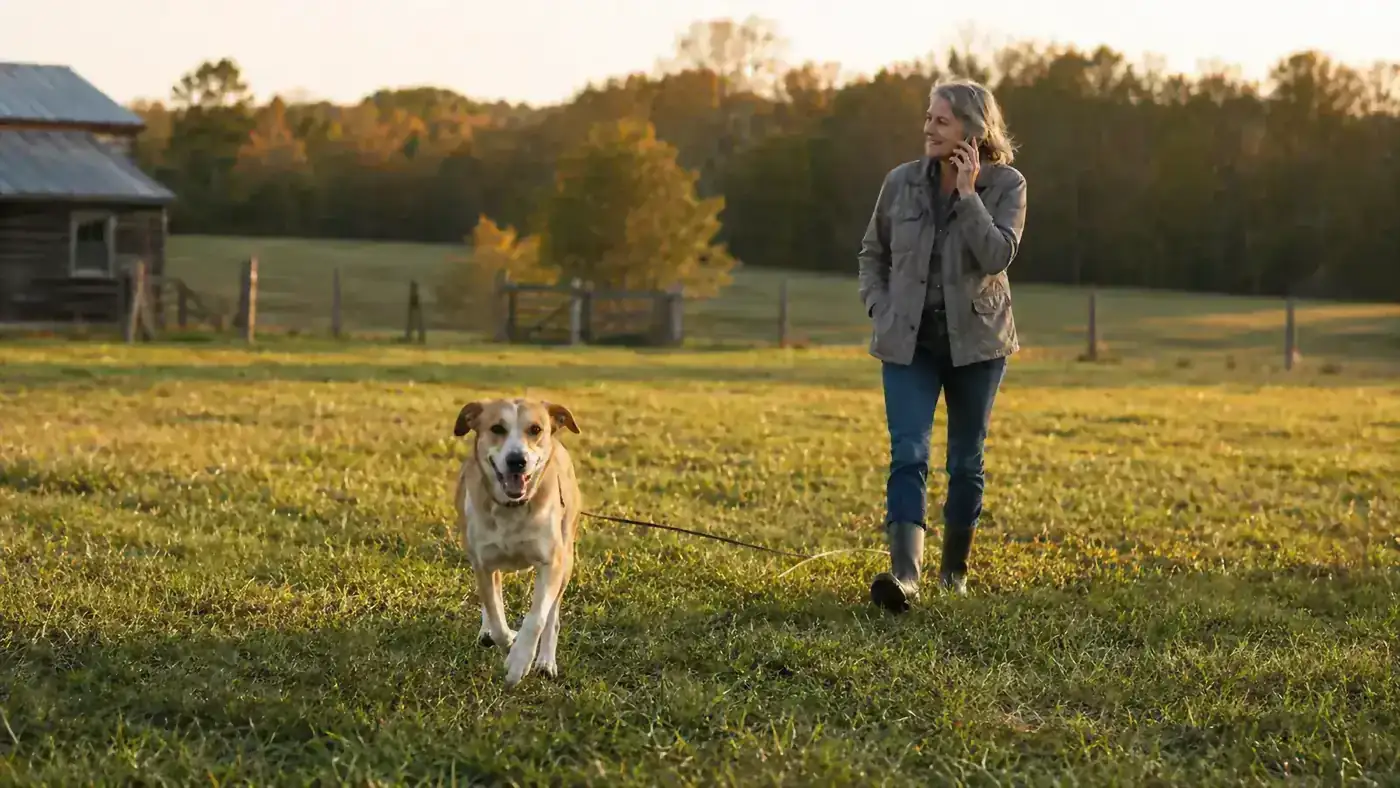
Ruggles will sit, stay, and shake on command in the kitchen like he graduated top of his class. Get him thirty feet out in the field behind our place with a rabbit trail crossing the grass, and every one of those cues evaporates. That gap between obeying indoors and obeying outdoors with real distractions is where most recall training actually dies, and it's the gap a long line is built to close. The tool I use for it, a flat thirty-foot lead from a company called Hi Kiss, has been clipped to Ruggles' harness for one full season now, spring through early fall, and it's the reason I can call him off a scent trail instead of chasing him across two properties in my barn boots.
Most recall failures aren't stubbornness, they're a training gap. The dog learns that come means something in a six-foot kitchen and nothing in a forty-acre field, because nobody ever proofed the cue at real distance with real distractions in the way. A long line closes that gap. It lets you build distance in stages while keeping a physical way to follow through when the dog decides a rabbit trail is more interesting than you are, which is exactly why a long line beats winging it off leash before the training is finished. None of it requires a shock collar, a whistle system, or any gear more complicated than a long piece of nylon and a plan you actually stick to.
Before You Drop the Leash for Good, Get One Tool That Buys You Time
A recall you can't trust yet isn't a recall you should be testing in an open field. The Hi Kiss long line gives you thirty feet, or a lot more if you need it, of real control while your dog is still learning, so a missed cue costs you a few steps of reeling in, not a sprint across the road.
Amazon Check Today's Price on Amazon →Step 1: Start on a Harness, Not a Collar
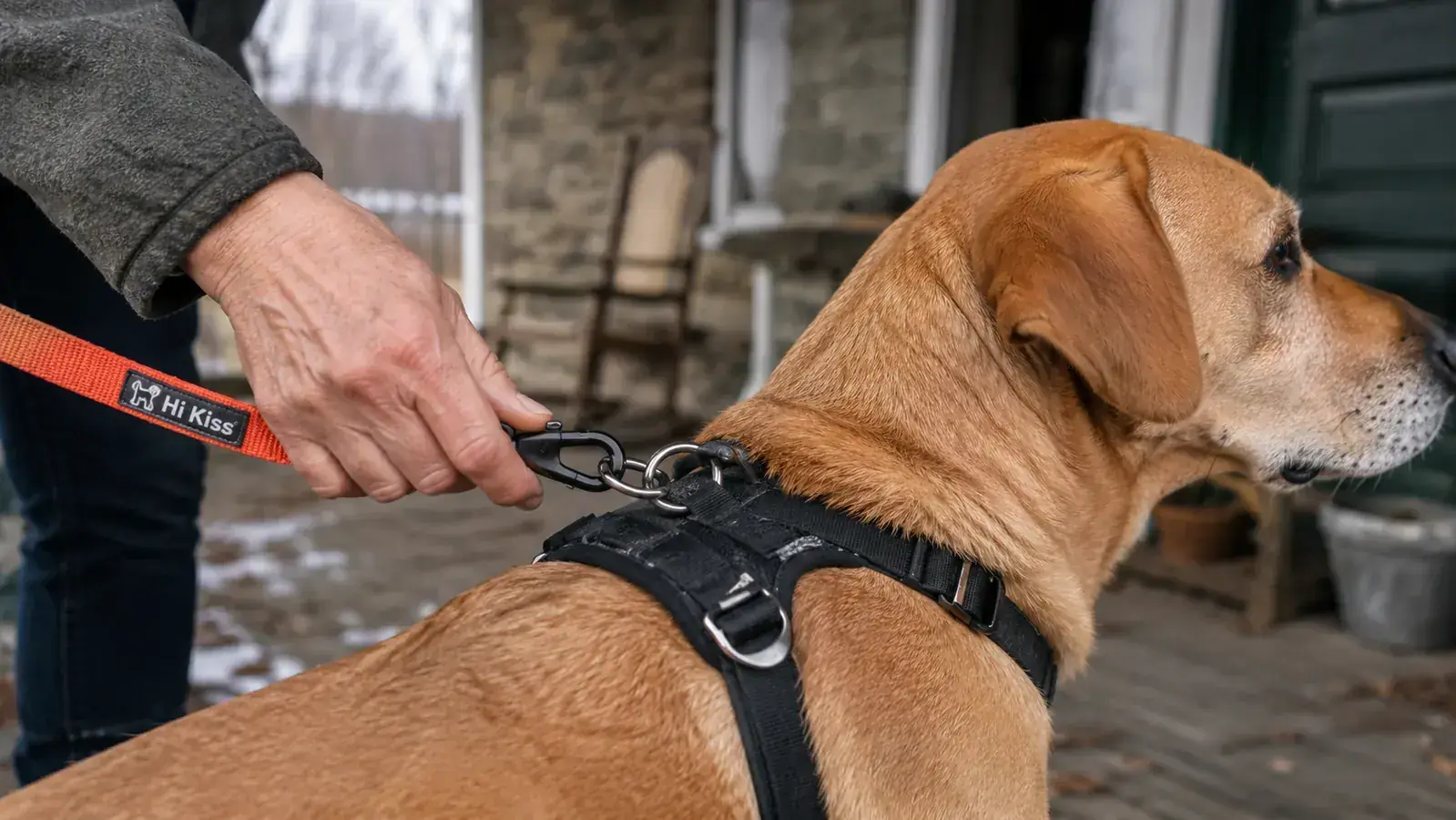
Clip the line to a well-fitted harness, never a collar. At thirty feet a dog can hit the end of the line at a dead run, and a collar puts all of that force straight against the trachea. A harness spreads it across the chest and shoulders instead. This matters more with a hound-nosed dog like Ruggles, who has hit the end of the line hard enough to spin himself around more than once chasing a scent he had no business chasing.
I run the Hi Kiss line clipped to a front-clip harness for anything past twenty feet, and I wear a pair of garden gloves whenever Ruggles is dragging it at a run. Thirty feet of nylon moving fast through a bare hand is a rope burn waiting to happen, and I learned that the first week, not gracefully, with a stripe across two fingers to prove it.
Never wrap the line around your hand or wrist to get a better grip. If the dog bolts, the line pulls tight and takes your hand with it. Hold it in loose loops instead and let it run through your palm if you have to. And never, under any circumstances, use a long line as a tie-out. It's a training tool you're actively holding and paying attention to, not a stake in the ground you walk away from while you go answer the phone.
Step 2: Build Distance in Feet, Not Leaps
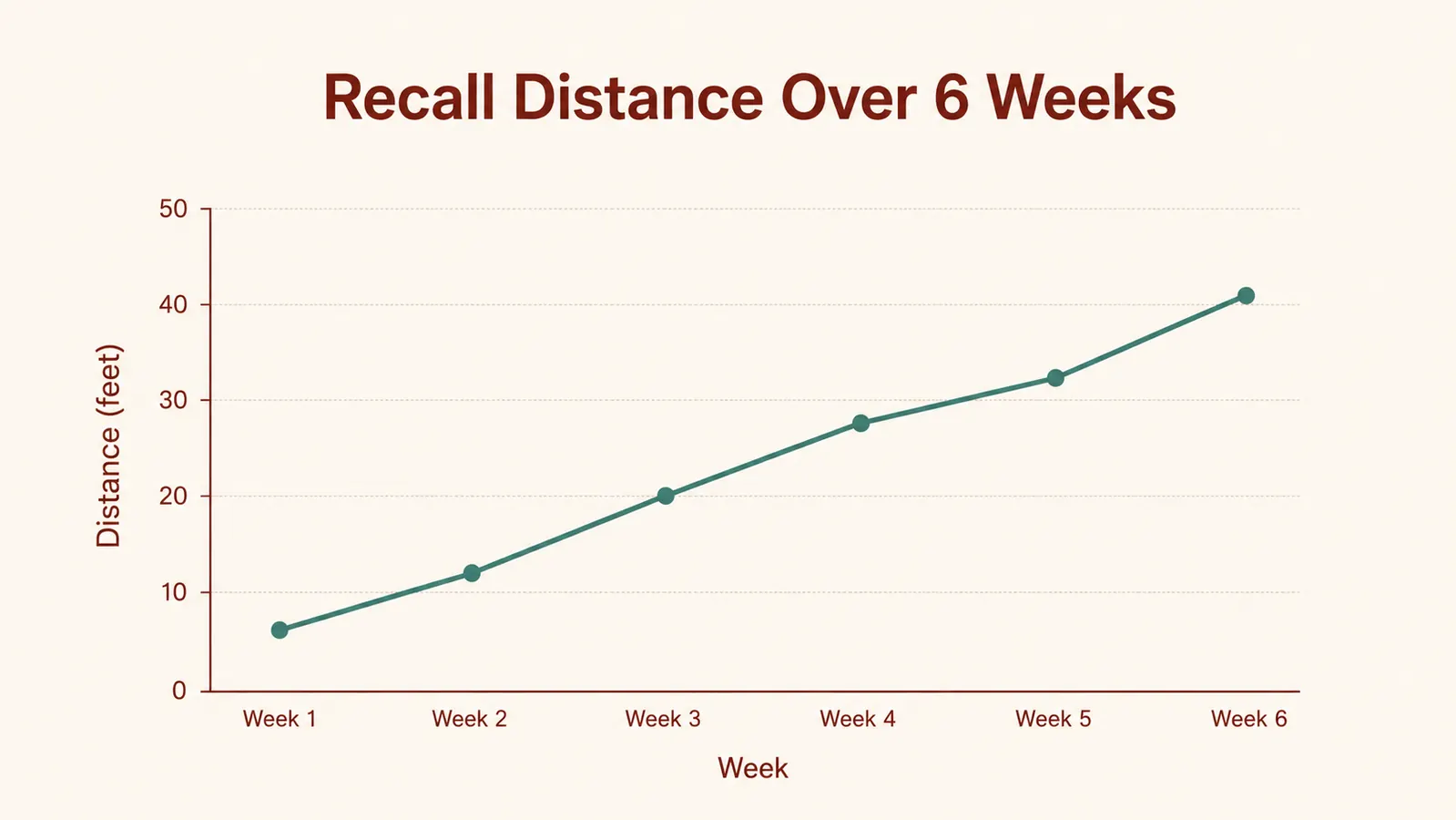
Start in the fenced yard at six feet, no farther. Call Ruggles, reward the instant he turns toward me, and only then start backing up in small increments, session over session, not command over command. A dog that's reliable at six feet and gets rushed to thirty feet the same week isn't being trained, he's being tested, and he usually fails the test.
The Hi Kiss line comes in lengths from fifteen feet up past a hundred, and the length you actually need depends on the space, not your ambition. I use a thirty-foot line for the field behind the house and switch to a fifty-foot line for the wider soccer field two towns over, where Alison sometimes meets me with a foster dog in tow to practice on neutral ground. Match the line to the space you're actually training in that day, not the space you wish you had.
Add distance in five-to-ten-foot jumps, and if a session goes sideways twice at a given distance, back up ten feet and rebuild confidence before pushing forward again. Recall is built in tiny wins stacked over weeks, not one triumphant Saturday afternoon that you then try to repeat too fast.
You'll know he's ready to move out another five feet when he's coming fast and straight, not slow and looping, and when he's doing it three sessions in a row without a hesitation at the current distance. Rushing past that sign is the single fastest way to build a recall that only works up close.
Step 3: Make the Reward Worth Leaving Whatever He Was Doing
A recall has to out-compete whatever the dog was already doing, whether that's a scent trail, a squirrel, or another dog at the park. Regular kibble doesn't out-compete much of anything. I use small pieces of real chicken or hot dog, cut smaller than a fingernail, reserved only for recall practice. Ruggles gets nothing that good for sitting politely at dinner. He gets it for coming when called, every single time, for the first several months of the season, and I'll throw in a jackpot of three or four pieces at once on the recalls that were genuinely hard for him.
Here's the rule that trips people up: never call the dog to you for something he hates. Don't call him over for a bath, a nail trim, to be put in the crate, or to get scolded for the thing he just did in the kitchen. If coming to you sometimes means good things and sometimes means the worst part of his day, he'll start hedging on which one it's going to be, and hedging is where recall quietly dies.
Go get him for the unpleasant stuff instead. Walk over, leash him, and lead him to the bath yourself. Save the recall word for things he actually wants: dinner, a walk, a game, coming back to you and then getting released to go sniff some more.
Step 4: Say the Word Once
Call "Ruggles, come" one time. Not three times, and not in a rising, increasingly annoyed pitch. Every repeated cue teaches the dog that the first two calls are just noise and the real deadline is somewhere around call number four. That's a cue you've poisoned yourself, one repetition at a time, usually without noticing you were doing it.
If he doesn't respond to the first call, don't call again. Use the line. Give it a gentle, steady pull, not a jerk, and reel him in while staying quiet or using a happy, encouraging tone, never a scolding one. The moment he arrives, reward like he did it perfectly, because from his perspective now he did.
This is the single biggest reason the long line beats an open field and good intentions. It lets you enforce the one-call rule without a shouting match across a pasture or a dog who's learned he can just keep running until you give up and chase him yourself.
Step 5: Proof It Against Real Distractions
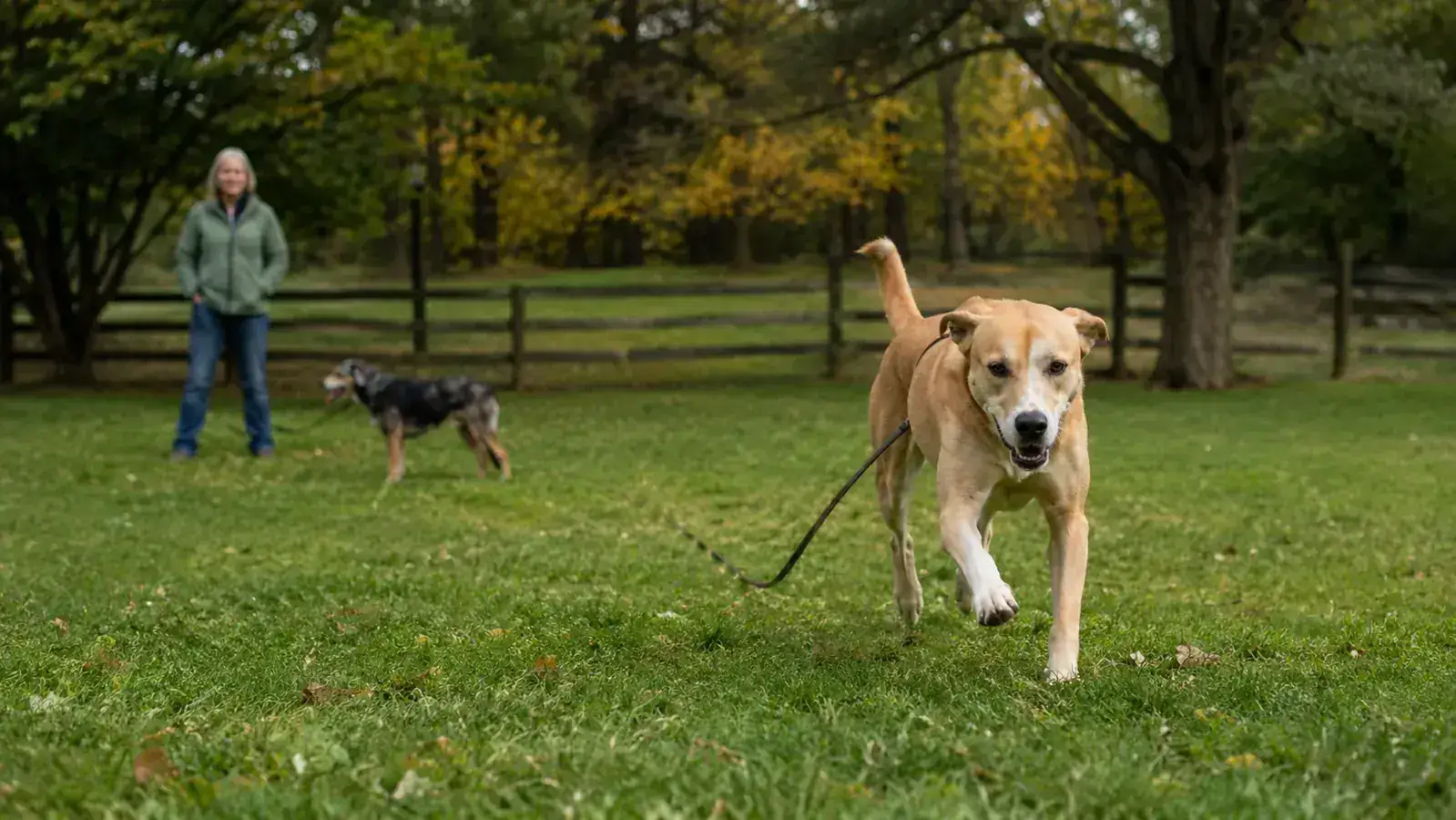
Once Ruggles is solid in the yard, I move him to harder settings, still clipped to the Hi Kiss line: the edge of the field where deer cross at dusk, the gravel lot at the feed store, the park in town on a busy Saturday morning. Each new environment resets the difficulty even though the distance is shorter, so I go back to close range before building distance again in the new place rather than assuming the training travels automatically from the yard.
Distractions get added on purpose, one at a time. First it's a person walking by. Then it's another dog on leash across the field. Then it's food dropped on the ground nearby that he has to ignore to come to me. This staged approach is also where a line beats a retractable leash, which extends and retracts unpredictably and teaches the opposite of a calm, controlled approach to a distraction.
Watch the line during all of this, especially around other dogs or kids running around. A loose thirty-foot line can loop around legs, ankles, or another dog's neck faster than you'd think, so keep it managed in loose coils in your hand rather than letting it snake freely across a crowded space.
Step 6: Know How to Repair a Poisoned Cue
If come has already been yelled in frustration, used to end fun, or followed by something the dog dreads enough times, the word itself gets contaminated. You'll see it as hesitation, a slower approach, or a dog who circles instead of coming straight in. That's a poisoned cue, and no amount of long line work fixes it if you keep using the same ruined word over and over.
Retire the word entirely. Pick a new one, something you've never used for scolding. I switched to "here" with Ruggles after "come" had one too many bad associations attached to a puppy stage I'd rather forget about. Start completely over at six feet in the yard, rebuild the new word from scratch with high-value rewards, and don't touch the old word again for anything, not even by accident.
Recovery is slower than the original training, usually another few weeks of short sessions, but it's faster than living with a dog who flinches or stalls every time you need him back for something that actually matters, like getting him off the road.
What Else Helps
A long line isn't the whole program, it's the safety net under the program. Pair it with a genuinely reliable sit and stay so you have a second tool if recall ever fails in a real emergency, and keep sessions short, five or ten minutes, several times a week, rather than one long frustrating slog on a Sunday afternoon. I keep the Hi Kiss line in the mudroom by the back door through the whole training season, spring straight through early fall, because the dogs who need it most are usually the ones who get walked the least once the weather turns and the line gets put away too early.
Once the long line work is solid across every setting I actually use, I'll drag a short, light line for a few more weeks before going fully off leash anywhere unfenced, mostly so there's still something to grab if a deer or a delivery truck shows up at the wrong moment. That drag-line stage is optional, but it's cheap insurance for the first season a dog earns real freedom, and it's a lot less dramatic than finding out the hard way that he wasn't quite ready.
A recall you have to repeat three times isn't a recall. It's a suggestion, and every dog knows the difference.
Ready to Build a Recall You Can Actually Trust?
You don't need a shock collar or a complicated system. You need distance you can control while the training is still in progress. The Hi Kiss long line is the same tool Ruggles trained on for a full season, and it's still hanging by the back door.
Amazon Check Today's Price on Amazon →